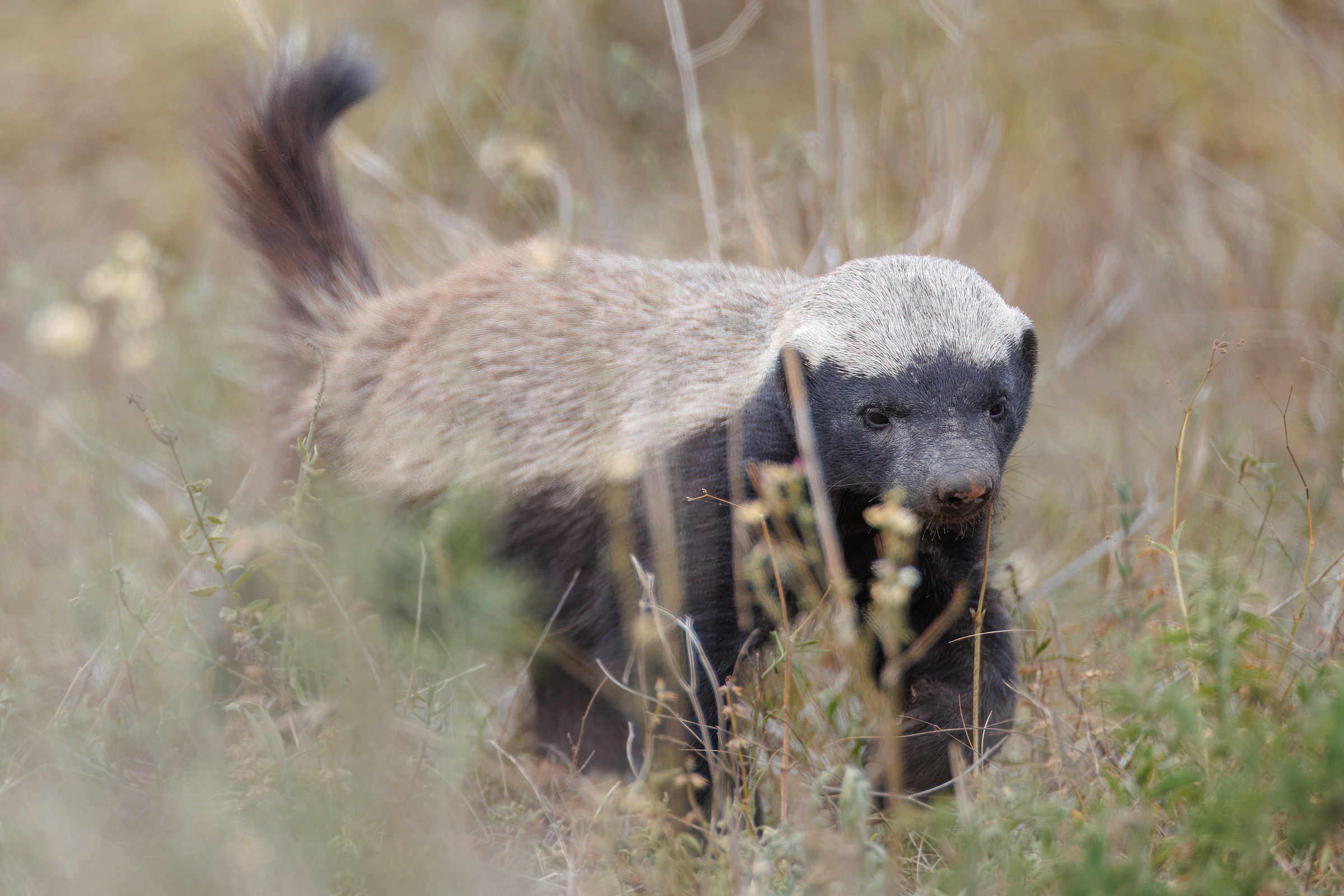
Mellivora capensis
Most of sub-Saharan Africa, from sea level to higher altitudes. This includes deserts, mountainous regions, and forests. It also ranges into western Asia and the Indian Peninsula.
Least Concern.
When threatened, it is usually due to beekeepers and farmers attempting to protect their charges with poison and traps. It may be that poisoning alone has destroyed pockets of honey badger populations.
The Neat Stuff
“Mellivora” means “honey-eater” in Latin, which is appropriate considering part of a honey badger’s diet is the honey from beehives (as well as the larvae within the hive). However, possibly contrary to expectations, honey badgers eat a wide variety of small animals, much of which they find by digging them out of their burrows. While primarily carnivorous, they’ll also eat berries and roots along with the aforementioned honey.
Honey badgers are famous (or infamous, depending on your perspective) for their ferocity and resilience. They can and will attack animals much larger than themselves if it means survival, including lions and hyenas. Their skin is loose while also being tough, making it difficult for predators (or farmer’s dogs) to successfully bite them. Naturally, this means bee stings rarely bother them — the same can be said for porcupine quills.