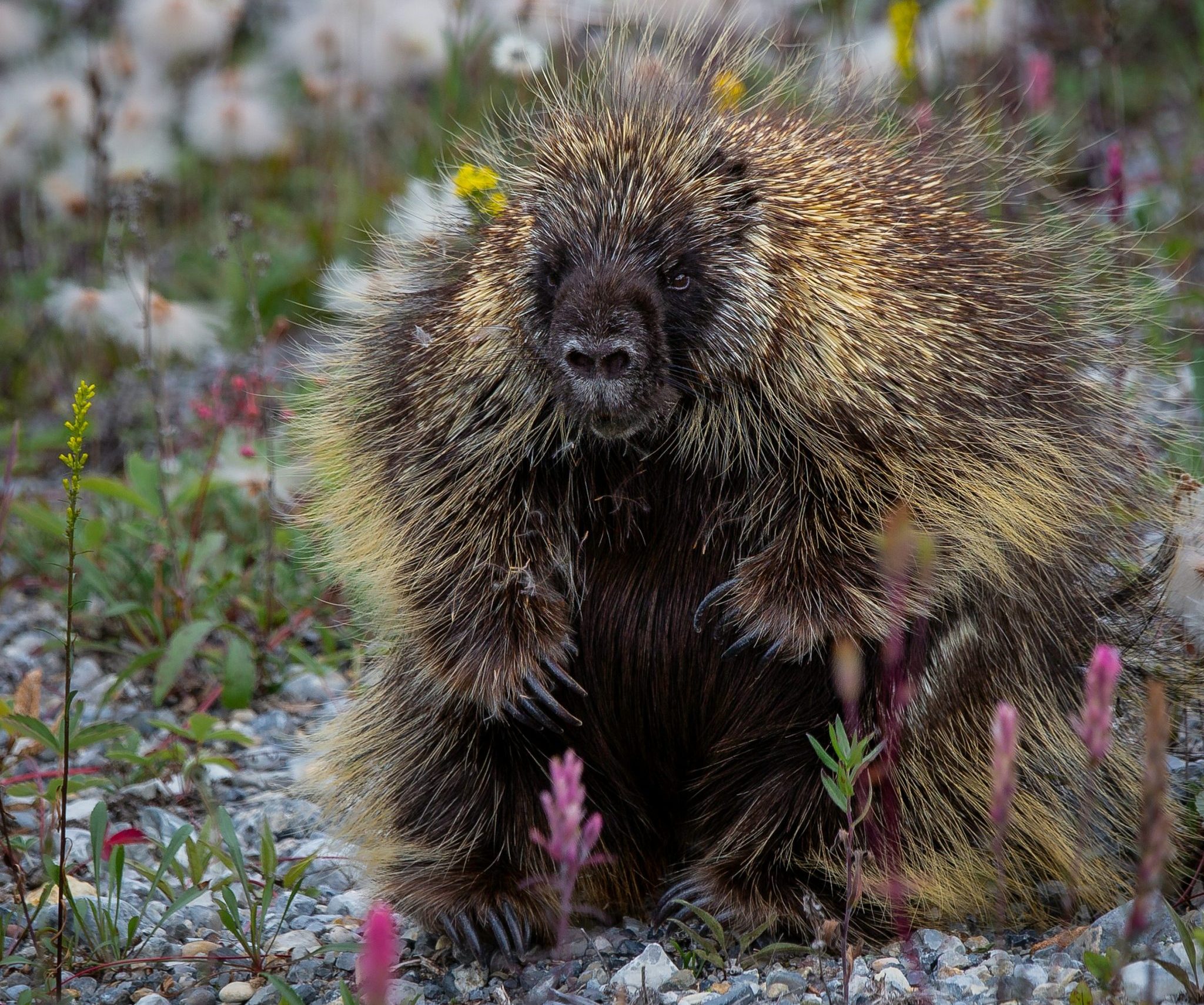
Erethizon dorsatum
| Kingdom: | Animalia |
| Phylum: | Chordata |
| Class: | Mammalia |
| Order: | Rodentia |
| Family: | Erethizontidae |
| Subfamily: | Erethizontinae |
| Genus: | Erethizon |
Appropriate to their name, the North American porcupine ranges across the states and Canada as well as the northern mountains of Mexico. Usually they are found in forested areas — especially those with coniferous presence — but some have adapted to harsher places like tundras and shrublands.
Least concern.
Porcupines are still common in most of their range, the exception being in the southeastern parts due to hunting and habitat loss.
The Neat Stuff
The porcupine’s famous protective quills inform more than just deterrence of predators — they also allow these herbivores to live largely solitary lives while other herbivorous mammals need to follow the strength-in-numbers approach. The quills also aren’t the only defense they have; they can emit a strong odor, bristle their quills to display a stripe on their back, and make warning sounds with their teeth. All of these defenses come first, and if a porcupine’s foe ignores them, then they can rely on their quills. These quills are not thrown, but the porcupine turns its back on the target and swings its tail. Contact alone is enough, as each quill has microscopic barbs that latch on and stay stuck in the predator’s face (it’s usually the face). This defense has a high rate of success.
Porcupines can live a relatively long life, up to 30 years.
They are nearsighted and don’t move especially fast, and they often don’t particularly need to get anywhere quickly. Running is not their go-to when faced with danger. It has been observed that porcupines have strong memories for navigating complex mazes, which may have something to do with their independent living in densely forested places.